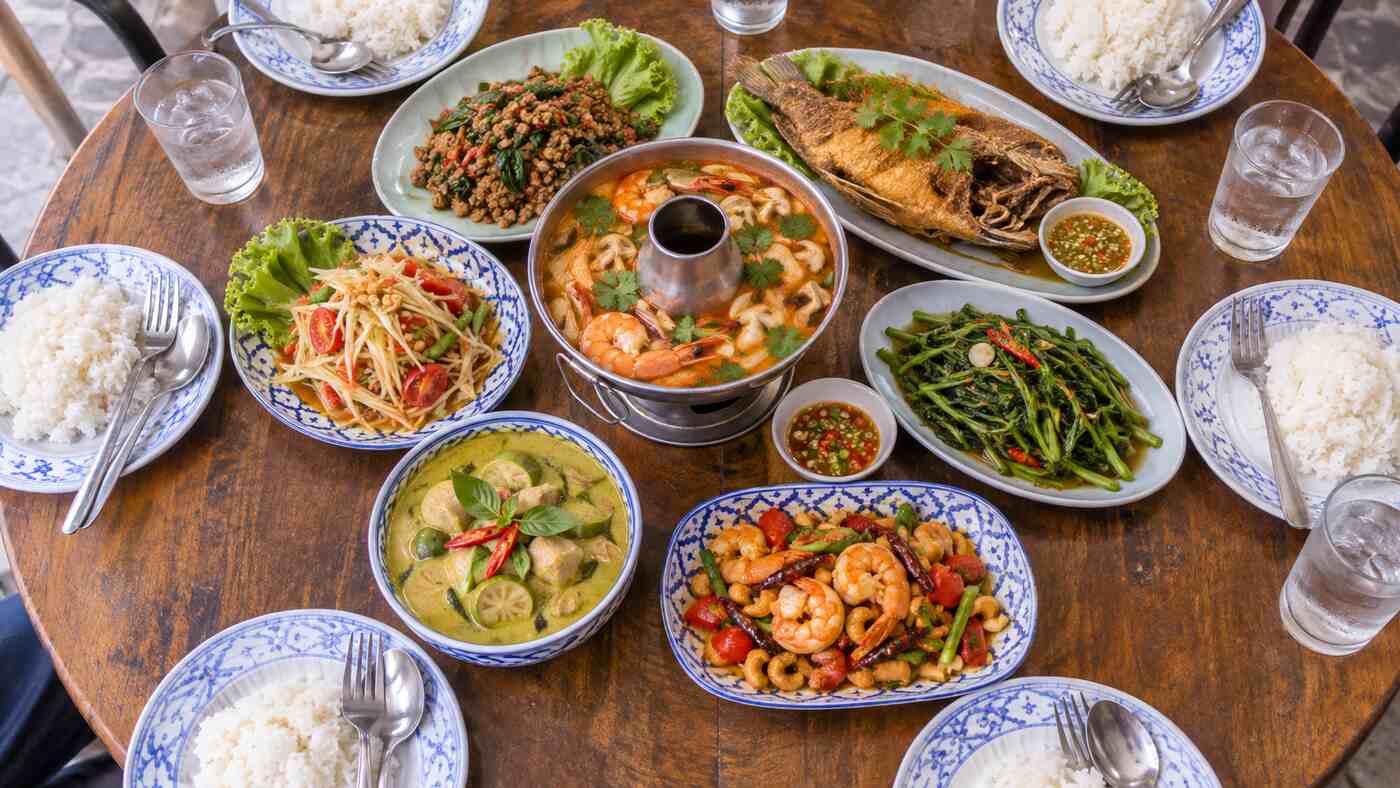
In short: Bangkok restaurants may add a service charge, usually 10%, but only if it is clearly shown on the menu or a sign. VAT is 7% until 30 September 2027. “++” on a menu usually signals both. At the table, Thai dishes are shared and served together, and most people eat with a fork in the left hand and a spoon in the right.
A first meal in a Bangkok restaurant raises two practical questions: what will the bill add, and how are you expected to eat? This guide answers both from official and reference sources, including the Bangkok Post’s reporting on consumer protection rules and Wikipedia’s entry on Thai cuisine. It does not cover tipping customs, on which we found no official guidance.
What is a service charge in Bangkok?
A service charge is a percentage that a restaurant adds to the bill for service, on top of food and drink prices. The Bangkok Post reported that the Internal Trade Department requires restaurants to state any service charge on the menu or on a sign. If it is not stated, diners can refuse to pay it. The charge is typically about 10%, and the department named a hotline, 1569, for complaints, with fines of up to 10,000 baht for breaches.
The 2025 consumer protection reminder
In 2025 the Office of the Consumer Protection Board (OCPB) issued a fresh reminder, the Bangkok Post reported. It said a service charge is optional for the business, should normally be no more than 10% and must be clearly displayed. Complaints can go to the Department of Internal Trade or the OCPB hotline, 1166.
VAT and what “++” means
Thailand’s value added tax is set by law at 10%, but a reduced rate of 7% applies. In August 2026 the government gazetted Royal Decree No. 807, extending the 7% rate to September 30, 2027, according to The Nation and Thomson Reuters. The 7% is made up of 6.3% VAT and a local tax.
Some hotel and restaurant menus mark prices with “++”. The sign is generally read as service charge and VAT both to be added, though the official sources above do not define it, so ask if unsure. As simple arithmetic, a 1,000 baht dish with a 10% service charge becomes 1,100 baht, and 7% VAT on that gives 1,177 baht.
| Item | Amount (baht) |
|---|---|
| Menu price | 1,000 |
| Service charge, 10% | 100 |
| Subtotal | 1,100 |
| VAT, 7% of subtotal | 77 |
| Total | 1,177 |
The example assumes VAT is charged on the service charge too; check your bill for how the restaurant applies it.
Fork, spoon and khluk
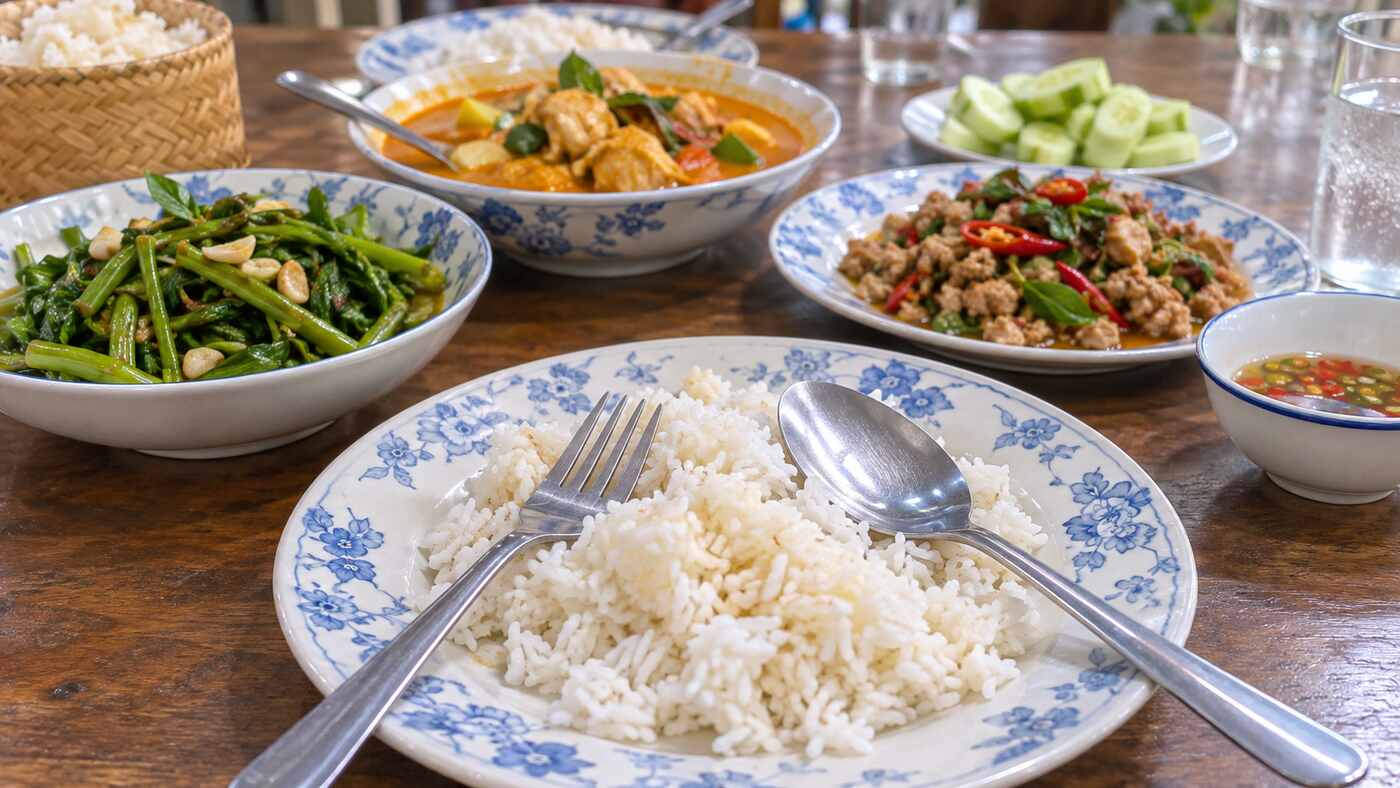
Most Thais eat with a fork and spoon, according to Wikipedia. The fork, held in the left hand, pushes food onto the spoon in the right, which goes to the mouth. Knives are not generally used at the table. Wikipedia notes that the fork and spoon were introduced by King Chulalongkorn after his tour of Europe in 1897, the same journey whose food diary inspires the Michelin-starred MACHRI (see our Michelin star guide).
Wikipedia also describes khluk, the practice of mixing the flavours and textures of different dishes with the rice on your plate. Chopsticks are mainly used for Chinese-style noodle soups and at Chinese, Japanese or Korean restaurants, which is why you will see them at Yaowarat’s noodle stalls.
Sharing dishes at a Thai meal
A Thai meal is typically rice with several dishes shared by everyone, all served at the same time, including soups, Wikipedia says. It is customary to order more dishes than there are guests. The tourism platform TAGTHAi adds that the host or the eldest person usually invites everyone to start, that diners use a serving spoon to take food from shared dishes and that people take small portions at a time.

Where Thai table manners came from
Many of today’s habits are relatively recent. Wikipedia says Thai food was traditionally eaten by hand while seated on mats or carpets, a custom still found in more traditional households. Tables and chairs were introduced as part of a Westernisation drive under King Mongkut, Rama IV, and the fork and spoon followed under his son, King Chulalongkorn. Chopsticks were foreign utensils to most ethnic groups in Thailand, with the exception of the Thai Chinese and a few other communities, such as the Akha people. That history is part of why a meal in a Bangkok shophouse, a Chinatown noodle stall and a Bib Gourmand restaurant can each feel a little different.
Sauces and condiments
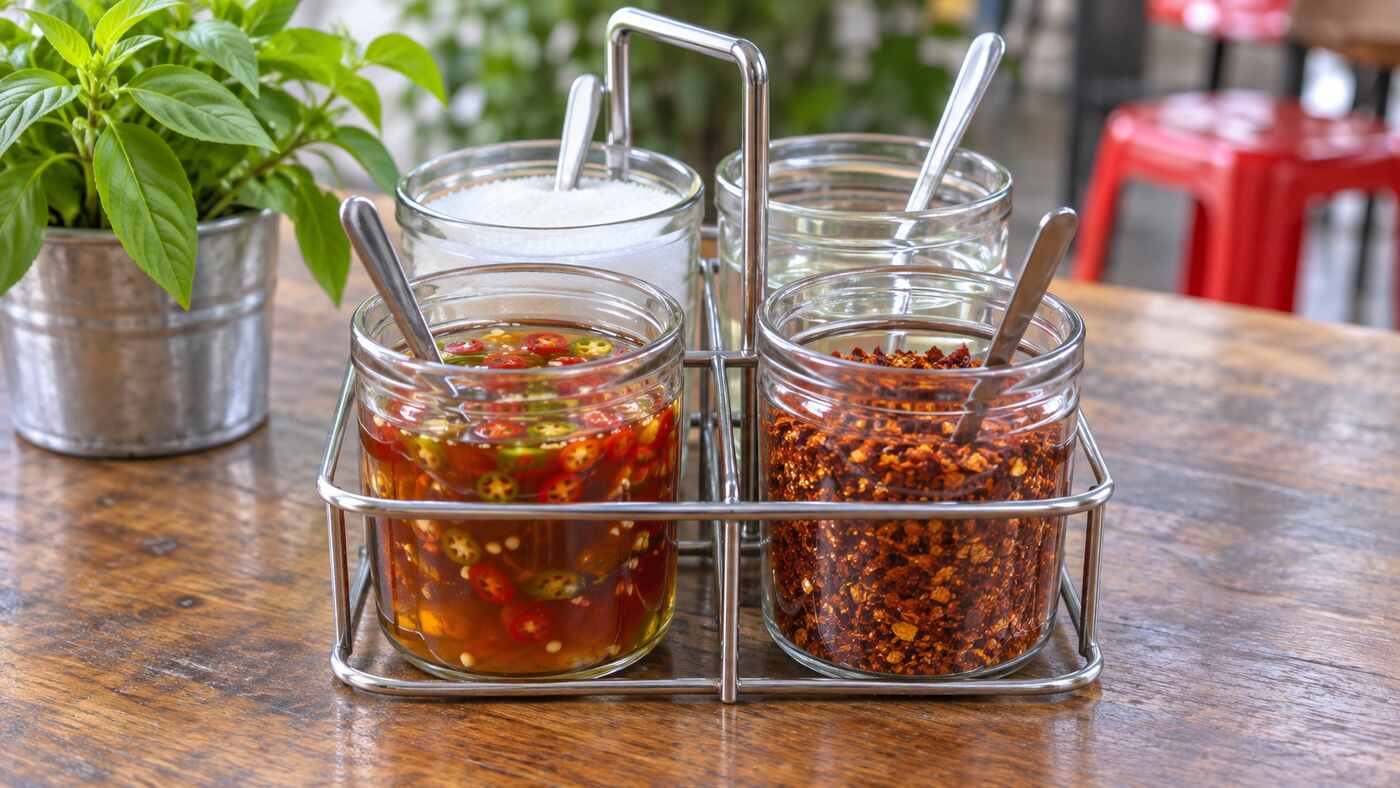
In most Thai restaurants, diners can season dishes at the table. Wikipedia lists the usual sauces and condiments as phrik nam pla (fish sauce with lime, chillies and garlic), dried chilli flakes, sweet chilli sauce, sliced chillies in rice vinegar, Sriracha sauce and sugar. They are brought by staff or kept on the table in small containers. Some dishes come with their own extras: with khao kha mu, pork trotter stewed in soy sauce and served with rice, Wikipedia says whole Thai chillies and raw garlic are served on the side. For how Bangkok’s awards began, see our history of restaurant awards.
Key takeaways
- A service charge, usually 10%, may be added only if it is clearly displayed.
- Complaints can go to the Department of Internal Trade or the OCPB on 1166.
- VAT is 7% until September 30, 2027, under Royal Decree No. 807.
- “++” on a menu is generally read as service charge plus VAT.
- Eat with a fork in the left hand and spoon in the right, and share dishes with a serving spoon.
Common questions
Is a service charge mandatory in Bangkok restaurants?
No. A restaurant may choose to charge one, but it must be clearly stated on the menu or a sign. The Bangkok Post reported that if it is not stated, customers can refuse to pay it. The consumer protection board says it should normally be no more than 10% of the bill.
What does ++ mean on a Bangkok menu?
“++” is generally read as meaning a service charge and VAT will be added to the listed price. With a 10% service charge and 7% VAT charged on top, a 1,000 baht item comes to 1,177 baht. Check the menu note or bill for the exact charges a restaurant applies.
What is the VAT rate in Thailand in 2026?
7%. The statutory rate is 10%, but a reduced 7% rate applies. Royal Decree No. 807, gazetted in August 2026, extends it to September 30, 2027, according to The Nation and Thomson Reuters. The 7% combines 6.3% VAT and a local tax.
Do Thai people eat with chopsticks?
Mostly not. Most Thais eat with a fork and spoon, pushing food onto the spoon with the fork. Chopsticks are mainly used for Chinese-style noodle soups and at Chinese, Japanese and Korean restaurants. Traditionally, Thai food was eaten by hand, a custom still found in more traditional households.
How we put this together: service charge rules come from Bangkok Post reports quoting the Internal Trade Department and the OCPB. VAT details come from The Nation and Thomson Reuters. Table manners come from Wikipedia and TAGTHAi. The “++” example is our own arithmetic from those rates, not an official figure.